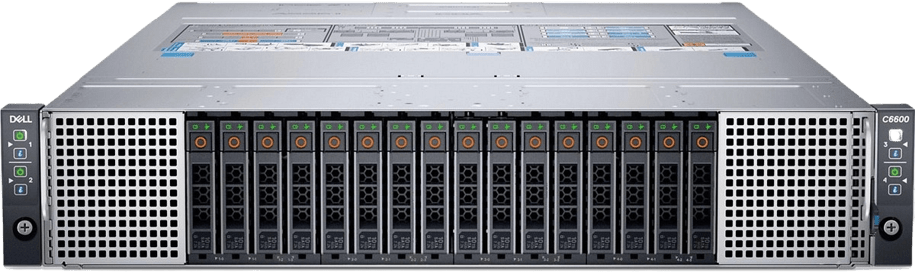
Dell’s PowerEdge C6600 emerges as a game changer in the ever-changing field of data-centric computing, challenging the bounds of density and performance. This ultra-dense 2U enclosure is a work of art, supporting up to four independent two-socket (2S) C6620 sleds and providing a plethora of capabilities that empower your data architecture.
Unrivalled Power Brought by C6620 Sleds:
The PowerEdge C6600 system is powered by four separate two-socket (2S) C6620 sleds, each a technical wonder capable of handling the most demanding workloads. This arrangement, powered by Intel Xeon processors, provides unmatched computational capabilities, ensuring your applications function at optimal efficiency.
Power Supply with High Redundancy:
With two redundant AC or DC power supply units, the PowerEdge C6600 provides uninterrupted power to your essential applications. This redundancy not only provides continuous performance, but also gives an additional degree of reliability to your data infrastructure.
Flexible Storage Options:
With compatibility for up to 16 x 2.5-inch SAS/SATA/NVMe (HDD/SSD) drives, you may embrace versatility. Whether you need high-capacity storage or lightning-fast NVMe SSDs, the PowerEdge C6600 easily adapts to your changing storage requirements.
NVMe SSD Drives E3.s:
With support for up to 8 x E3.s NVMe SSD drives, you may enjoy unprecedented speed and responsiveness. This cutting-edge technology speeds data access, making it perfect for latency-sensitive applications and workloads that require a lot of data.
Diskless Configuration for Optimum Performance:
The diskless configuration option on the PowerEdge C6600 allows you to improve your data environment by centralizing storage resources. With this forward-thinking strategy, you may eliminate the limits of local storage, minimize complexity, and increase the agility of your
system.
Maximum Impact in a Small Package:
The PowerEdge C6600 is a high-performance server with an ultra-dense 2U package factor.
It’s a powerhouse that saves space and thrives in areas where optimizing processing capacity within a small footprint is critical.
 Avileon Holdings Inc