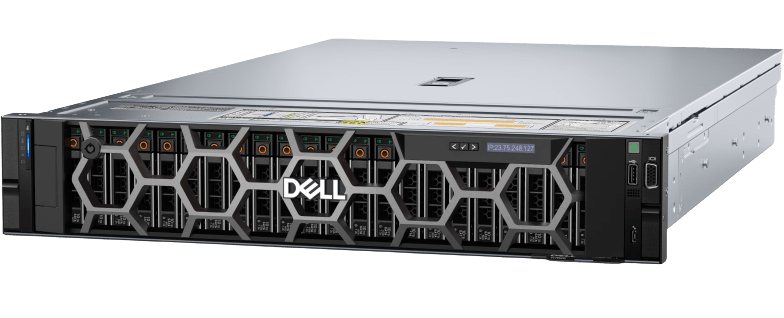
The Dell PowerEdge R7625 is a 2U dual-socket rack server that redefines data centre performance and versatility. This high-performance server is built to move your company ahead with breakthrough innovation, offering extraordinary performance in air or Direct Liquid Cooled (DLC) configurations.
The R7625 is designed to support both classic and new workloads, including High-Performance Computing (HPC), Virtual Desktop Integration (VDI), and virtualization. With the most recent performance and density choices, as well as optional acceleration, it keeps you ahead of the curve in the ever-changing environment of data centre needs.
The R7625, which is powered by AMD EPYC 4th generation CPUs, has up to 50% higher core count per single socket platform. Accept DDR5 memory at 4800 MT/s and PCIe Gen5, which doubles the speed of previous Gen4 for quicker data access and transport—optimizing application output. Optional DLC cools high-performance CPUs effectively, ensuring your server is ready for the most demanding tasks.
Increased core count and memory footprint provide greater virtual machine density. Power users can benefit from up to 6x single-wide full-length or 2x double-wide full-length GPUs, which improves responsiveness and reduces application load times.
Scale your storage by adding up to 33% more E3.S NVMe drives*, lowering your carbon footprint while increasing data storage on a single server. DDR5 memory capacity (up to 6 TB) with support for reduced latency, faster performance NVMe SSD in a hardware RAID solution maximise computational performance.
With integrated protection throughout the PowerEdge lifespan, security is a primary focus. End-to-end boot resilience is ensured by a silicon-based root of trust, while Multi-Factor Authentication (MFA) and role-based access restrictions assure trusted operations in a Zero Trust IT environment.
The Dell OpenManageTM systems management portfolio provides safe, efficient, and comprehensive solutions for the R7625. Through the OpenManage Enterprise interface and iDRAC, simplify, automate, and centralise one-to-many management, speeding operations in an autonomous environment.
 Avileon Holdings Inc